Names are an important part of our identity. They can emphasize our uniqueness, a connection to a family member or a tie to our heritage. In this lesson, students will explore the personal and cultural meaning of their given names. This lesson provides an opportunity for students to learn more about their names and aspects of their identity through family interviews, research and poetry.
Objectives
- Students will interview family members to learn about their names.
- Students will learn the meaning and origin of their names.
- Students will research their names in books and online resources.
- Students will apply information about their names in order to develop a bio-poem about themselves.
- Students will recognize the importance of names in the preservation of one’s culture.
Materials
- Projector
- White board and markers
- Supplies for the creation of a nameplate poster board
- markers and construction paper
- Baby naming books checked out from the library
- Internet access to websites on names and origins
- Appendix A – The History of My Name (assign for homework the day before)
- Appendix B – These Are the Names By Sami Shalom Chetrit
- Appendix C – Bio Poem
| NOTE TO TEACHER
Before teaching the lesson, decide if you will focus on students’ given and/or Hebrew names. Some students will have both, some may not have a Hebrew name. |
Procedures
Introduction
- WRITE the Main Questions on the board:
- What do our names mean to us, our families and our communities?
- How can we celebrate and honor the diversity of our Jewish community through names
- INFORM STUDENTS that they will be learning about their names, where they come from and what they mean to our community.
- Remind them that different communities have diverse naming traditions. For example, most Ashkenazi families name children in honor of family members who are deceased while in some Mizrahi and Sephardi families, children are named to honor living relatives.
- ASK the students what they know about the origin of their names. You can share with them the origins of your name.
- READ A POEM (Appendix B) about the importance of names.
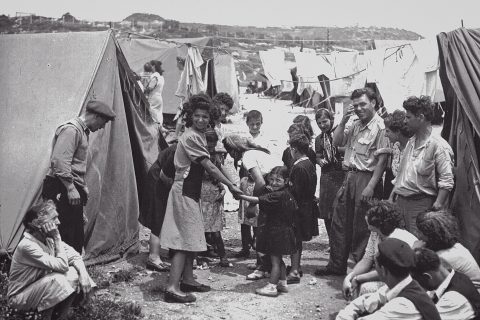
- This poem, entitled “These are the Names” By Sami Shalom Chetrit describes the types of names Jewish immigrant from North Africa had upon their arrival in Israel. It explores the challenges immigrants face when arriving in a new country and how significant the retention of names can be in the preservation of culture. For more background on the poem, refer to teachers notes in Appendix B.
- DISCUSSION QUESTIONS:
- What kind of names did the immigrants have in the beginning of the poem?
- Why do you think the teacher changed the student’s names?
- How do you think it might feel to have your name changed
- What did the students do when their names were changed?
- Why was it important for them to preserve the names they brought with them from Morocco?
- Why are names important? What do they say about who we are?
- HAND OUT Appendix B and tell the students that they will interview their family to learn more about the origin of their names. (The next part of the lesson can be held the following day, or you can hand out Appendix B as a homework assignment prior to the lesson).
Body of Lesson
- STUDENTS PAIR UP with a buddy.
- STUDENTS SHARE with each other new information that they researched about their names (from Appendix B that they filled out at home).
- Students share one interesting fact they discovered from the interview.
- REFLECT on the interview process with their family members.
- Was it helpful to ask questions about their names and identity?
- Did they learn something about their family’s history?
- TELL students that they will create personalized nameplates that will include additional details about their names that they are going to learn (language/culture of origin, pronunciation, history, Biblical connection, Hebrew spelling, personal connection to my name etc.)
- EXPLAIN to them that:
- The study of names is called “onomastics” – a field which touches on linguistics, history, anthropology, psychology, sociology, philology and much more.
- When people refer to the “meaning of a name”, they are most likely referring to the etymology, which is the original literal meaning.
- Sample websites on the etymology of given names: Behind the Name – Etymology, Baby name Wizard
- PROJECT IMAGE below on the board (Click here).
- REVIEW the different concepts and definitions that relate to names and “onomastics”.
- Pronunciation
- Alternate spellings and related names
- Popularity rating
- Gender (masculine, feminine, unisex)
- Language/Culture of origin
- Etymology= the history and meanings of names
- TELL students that they will create personalized nameplates that will include additional meanings about their names (gender, language/culture of origin, pronunciation, history, Biblical connection, Hebrew spelling, etc.) For example:
- SET OUT a basket with a variety of baby naming books borrowed from the public library.
- If there is internet access, allow students to use the classroom computers to research websites that describe the etymology and history of first names.
- STUDENTS CREATE and decorate their own personalized nameplates on construction paper or poster boards. (The teacher can prepare an example of their own nameplate, with decorations and explanations of their name to show the students.) The students will incorporate information they’ve learned from the interviews. They will also have space to represent themselves and their names through this creative art project.
- Here is a sample of a graphic organizer that you can project on the board while students are working. (Click here).
- STUDENTS DISPLAY their nameplates around the room and classmates walk around, read, and respond to information they’ve learned about their peers’ names.
- DISCUSS the origins of the various names:
- What do our names say about ourselves?
- What do they say about our families?
- What do they say about our community?
- DISCUSS the origins of the various names:

Conclusion
- HAND OUT Appendix C.
- STUDENTS WRITE their bio poems by using information from family interview and their name research.
Extension Activities
- STUDENTS CREATE visual displays of their name research findings and share the research in small groups or in a “gallery walk” format.
- STUDENTS RESEARCH the names of family members, historical figures, etc. and present them with a personalized nameplate.
- STUDENTS RESEARCH the origins of their surnames.
Resources and External Links
What’s in a Jewish Name? – Jewish traditions for selecting a child’s name
From http://www.myjewishlearning.com/article/naming-children/
SephardicGen
From http://www.sephardicgen.com/names.htm
Midreshet: Jewish Textual Resources
From http://midreshet.org.il/ResourcesView.aspx?id=873
My Name Is…
From https://poetry.arizona.edu/education/curriculum/my-name
Who Am I? Identity Poems
Who am I? Using Personal Narrative to Reflect on Identity
From https://digitalcommons.trinity.edu/cgi/viewcontent.cgi?article=1253&context=educ_understandings
The Last Name Israelis Are Most Keen to Shed: Mizrahi