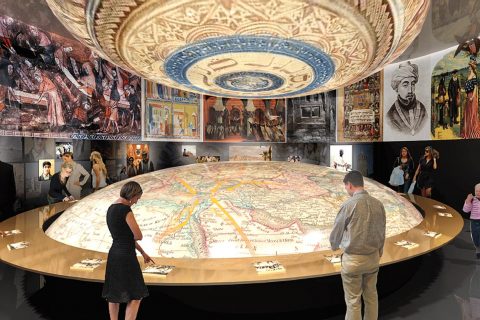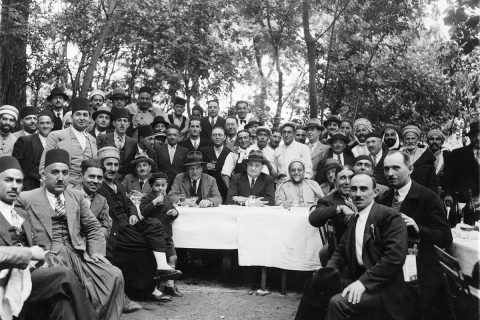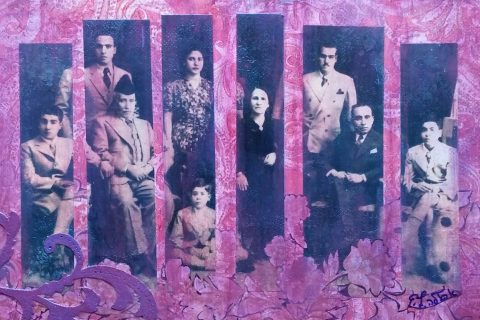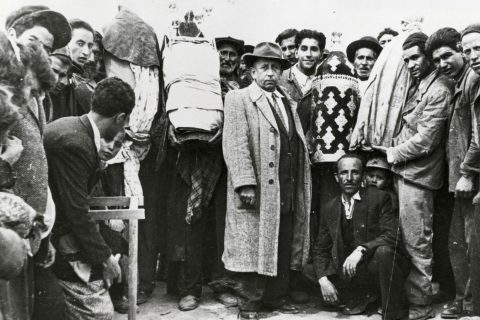
The aim of this lesson is to provide students with the opportunity to learn about the forgotten Jewish refugees of the Middle East and North Africa, view scenes and interviews of Jewish refugees who fled Arab lands in the early 1950s and draw connections to these refugees and their relationship to the creation of the State of Israel in 1948. An art activity will deepen their understanding of the refugee experience and promote empathy for what it means to be a “stranger.” Written by Galia Avidar
Objectives
- Students will know the term “refugee” and will understand the advent of Jewish refugees in the Arab world.
- Students will get to know individuals who are Jewish refugees from Arab lands and will express their stories in art form.
Materials
- Projector and computer
- PowerPoint presentation for Lesson 3
- Source sheets
- Whiteboard and markers
- Supplies for collage art project
- photos, newspapers, magazines
- construction paper
- glue sticks
- scissors
- APPENDIX A – Text from Rabbi Ezra Sasson Dangur
Procedures
Introduction: What is a Refugee?
- Write the main questions on the Board:
- What is a refugee?
- Who are the Jewish refugees from the Arab world?
- What can we do with the memories of their suffering?
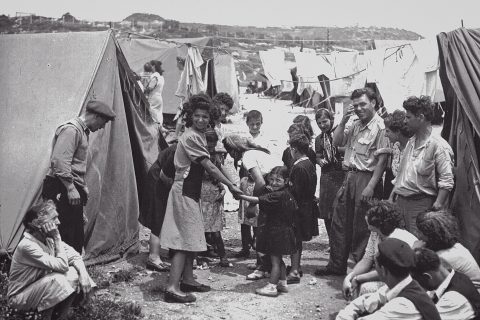
- PPT SLIDE #2 Images of Refugees ASK the students:
- What is going on in these photographs?
- Where do you think these people are going? Why?
- What do you think they are carrying with them?
- How do you think they feel? What are these people called?
- PPT SLIDE #3– Definition of Refugee from UN website
- PPT SLIDE #4 – Map of the Middle East
- READ the title on this slide.
- ASK:
- Does anyone know why Jews fled from Arab lands?
- What happened in 1948?
- Why were Jews fleeing their homes?
Body of Lesson
- NOTE TO TEACHER: Before beginning the video segments, draw the students’ attention to the title of the documentary on PPT SLIDE #5: Forgotten Refugees. ASK:
- Who are they talking about?
- What does this title mean?
- Is anyone familiar with Jewish refugees in Jewish history who were forgotten?
- They are aptly called the “Forgotten Refugees.” While the world is fully aware of the hundreds of thousands of Palestinian Arabs displaced in the wake of the war launched by multiple Arab armies against the establishment of the Jewish state in 1948, the world — including many Jews — is singularly unaware of or uninterested in the greater number of Jews who were expelled from Arab countries, where they had roots dating back more than 2,500 years.” Explanation and article for background information: The Forgotten Refugees
- PPT SLIDES #6-9: feature video clips from the film “Forgotten Refugees.” The four brief video clips provide a summary of:
- How Jews migrated to the Middle East (5min.)
- The Jews Relations with Arabs (1.5min)
- The Impact of WW11 on Middle Eastern Jews (1min)
- How the State of Israel provided freedom for Jews from Arab lands (1.5min)
- As students watch video clips, pause the video during sections you deem relevant.
- WRITE ON BOARD: key words, thoughts, questions, that students raise.
- During the activity STUDENTS WRITE these words and definitions which they will later incorporate into their collage. Pause and discuss key concepts in all 4 video clips.
- PPT SLIDE #10 – How Many Jews are in these countries today?
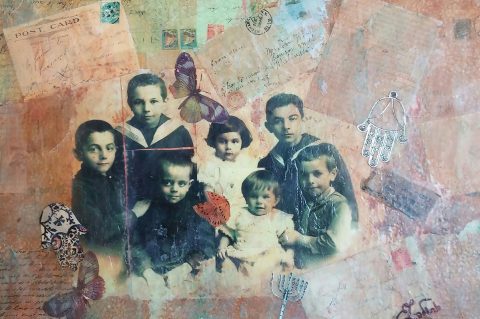
- PPT SLIDE #11 – Samples of Refugee Collages. Explain to the students that they will create an art piece that will describe the story of a Jewish refugee. Students will use words and images from the film that remind them of life in Arab countries, challenges, history, and the escape or migration to Israel or elsewhere.
- Discuss: Why are we creating a collage? Review with the students the driving questions of this lesson. Remind them of the name given to these Jews, “Forgotten Refugees.” They can be proactive and make a positive change by helping to transform status of these forgotten refugees to remembered refugees.
- A collage is a technique of an art production, primarily used in the visual arts, where the artwork is made from an assemblage of different forms, thus creating a new whole. A collage may sometimes include magazine and newspaper clippings, ribbons, paint, bits of colored or handmade papers, portions of other artwork or texts, photographs and other found objects, glued to a piece of paper or canvas.
Conclusion
- After creating their collage, students present them, and/or they can be displayed around the school to remind the community of these forgotten refugees.
- Discussion Questions:
-
- What images did you choose for your collage? Why?
- What words, phrases, quotes best captures this experience? Why did you choose them?
- What new information did you learn from the film?
- With whom will you share the story of the “Forgotten Jews” so that their experience will be remembered?
Extension Activities
- Students can be invited to read or watch videos of JIMENA’s oral histories to hear more about individual Jewish refugee experiences from the Arab world. Students create a collage, write a summary, diary entry, letter to a friend describing the refugee experience. Students compare refugee experiences
- Students interview members of their families / school community who are from Middle Eastern and North African countries to learn more about the refugee experience. Recording oral histories helps us to remember these refugees. Students can use the Seeing the Voices Mobile Application to guide them through the process. Each testimony collected with the app is automatically added to Israel’s official international database of Sephardic and Mizrahi testimonies.
- Older Students: What do we do with these memories of expulsion? As Jews living in a world with so much suffering, refugees, displaced peoples and disadvantaged communities, what do we do with these memories of suffering and expulsion from Arab countries and other places in the world?
- Pass out text from Appendix A. Students will read a short text by Iraqi Rabbi Ezra Sason Dangur (1848-1930) from his book, Adey Zahav Al Hatorah.
- This text will help us answer this important question: What do we do with these memories of expulsion? Read the text together and then answer the following questions.
- How does Rabbi Dangur address the question of Jewish suffering?
- What are we supposed to do as Jews who have experienced suffering?
- What do you think the children of refugees should do when they see suffering in the world?
Resources and External Links
What is a Refugee?
From <https://www.unrefugees.org/refugee-facts/what-is-a-refugee/>
What is the difference between an asylum seeker, a refugee and an asylee?
From <https://www.hias.org/hias-what-difference-between-asylum-seeker-refugee-and-asylee>
In Honor of Jewish Refugees from Arab Lands: Letter from a Forgotten Jew
From <https://www.huffingtonpost.com/david-harris/in-honor-of-jewish-refuge_b_13305628.html>
Fact Sheet: Jewish Refugees from Arab Countries
From <https://www.jewishvirtuallibrary.org/jewish-refugees-from-arab-countries>
World Jewish Congress urges UN to recognize Jewish refugees from Arab lands
Jewish Refugees from Arab lands Seek justice at United Nations:
Descendants of the 850,000 Jews expelled from Middle East countries from 1948 to 1970 look to set the historical record straight
From <http://www.timesofisrael.com/jewish-refugees-from-arab-lands-seek-justice-at-united-nations/>
Forgotten Refugees Film
From <http://www.jimena.org/resources/forgotten-refugees/>
The Forgotten Refugees (Full Documentary Movie)