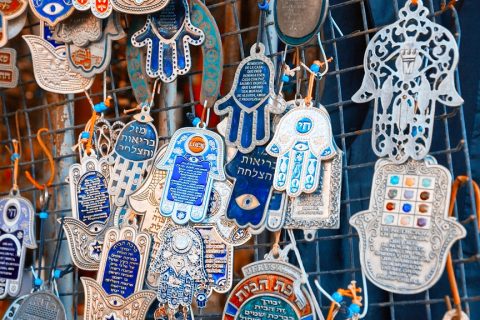
The hamsa, a palm-shaped amulet popular throughout the Middle East and North Africa, is frequently used in jewelry and wall hangings. It is a universal symbol, represented in many religions and cultures. The aim of the lesson is to familiarize students with the meaning of the hamsa for Middle Eastern and North African Jews.
Objectives
- Students will learn about the symbolic meaning of the hamsa.
- Students will compare the similarities and differences between Muslim and Jewish hamsas.
- Students will draw connections, through Jewish texts, between the symbol of the hand and tzedakah (giving to those in need)
- Students will design their own hamsa.
- Students will discuss the best ways to give tzedakah.
Materials
- Hamsa amulets or images of hamsas
- Hamsa art project- heavy cardstock or blank wooden hamsa shapes, scissors, templates, cord, paint, glitter, glue, etc.
- Appendix A Materials (Henna Party Celebration)
Procedures
Introduction: Why do we open our hands?
- DISPLAY a few hamsa amulets for the students to see. (Note: hamsas are inexpensive and can be purchased online. You may also print some images of hamsas to show the students)
- TELL students that today they will learn about the hamsa and its connection to Middle Eastern and North African Jewry.
- WRITE the Main Questions on the board:
- What does an open hand mean?
- When do we open our hands for others?
- Why do we wear and decorate our houses with Hamsas?
- ASK the students:
- Have you ever seen a hamsa?
- What do you know about the hamsa?
- What do you see on the various hamsas?
- HAND OUT Appendix A. The Appendix is divided into 2 sections:
- In the first section of Appendix A, students compare the similarities and differences between the Muslim and Jewish hamsas. NOTE TO TEACHER: If you taught lesson 2 on acculturation, here is a good opportunity to review the term and discuss how both cultures hold shared beliefs about protection and the evil eye.
- In the second section, there are Jewish texts that help students understand the symbolism and connection of the hamsa to Jewish life and mitzvoth. This section focuses on the symbol of the open hand and will invite students to think about the representation of an open hand.
- Before reading the text, ASK the students: When in life do we need to “open our hands”? They might say we need to open our hands to shake hands with our friends, to “do” things or take action or to get things done. If they are having a hard time you can ASK: When do we close our hands? (When we make a fist to fight someone? When we don’t want to share a toy or something we have?).
- READ the short text from the book of Deuteronomy 15, found in Appendix A and below, which explores the issue of poverty and offers some “directions” on how to deal with this problem in our society: Deuteronomy 15:7-8 If there be among you a needy man, one of thy brethren, within any of thy gates, in thy land which the LORD thy God giveth thee, thou shalt not harden thy heart, nor shut thy hand from thy needy brother; but thou shalt surely open thy hand unto him, and shalt surely lend him sufficient for his need in that which he wanteth.כִּי-יִהְיֶה בְךָ אֶבְיוֹן מֵאַחַד אַחֶיךָ, בְּאַחַד שְׁעָרֶיךָ, בְּאַרְצְךָ, אֲשֶׁר-ה ‘ אֱלֹהֶיךָ נֹתֵן לָךְ–לֹא תְאַמֵּץ אֶת-לְבָבְךָ, וְלֹא תִקְפֹּץ אֶת-יָדְךָ, מֵאָחִיךָ, הָאֶבְיוֹן כִּי-פָתֹחַ תִּפְתַּח אֶת-יָדְךָ, לוֹ; וְהַעֲבֵט, תַּעֲבִיטֶנּוּ, דֵּי מַחְסֹרוֹ, אֲשֶׁר יֶחְסַר לו דברים טז ז-חStudents answer the question below and discuss as a group:
- ASK What does this text instruct us to do when we encounter poverty in our community?
- Continue the discussion with a commentary on the above text by Algerian Rabbi Yeshua Lalum:
על כן התורה מצווה “לא תאמץ את לבבך ולא תקפץ את ידך” אם תקשה לבך ידך תיסגר שאז האצבעות שוות ואז תאמר לו, לך תעבוד כמוני, אלא כי פתוח תפתח את ידך, ואז תראה האצבעות שיש ביניהן גדולים וקטנים, כך ברא הקב”ה בבני אדם, גדולים וקטנים וזה חי מזה”
רבי ישועה ללום, ליקוטי אהרן, דרשה י”ז
“And so the Torah commands us, ‘Do not harden your heart and do not close your hand” to the needy. If your heart hardens, your hand will close, and you will see that your fingers are of equal length and then you will say to him (the poor person)-Go out and work like me! But do the opposite, open your hand and then you will see that your fingers are short and tall and this is how God created people, big and small, and this lives from that” – Likutey Aharon, Rabbi Yeshua Lalum 1901-1950)
| Rabbi Yeshua Lalum, Rabbi and Community Leader in the Algerian Jewish community. At age 18 he was ordained and throughout his life served as the Rabbi of several cities in Algeria and in Europe. He was responsible for the instruction of many students and took on many community roles (cantor, ritual slaughterer, and teacher). Rabbi Lalum was instrumental in the development of vibrant Jewish communities all over Algeria. He died at the age of 49. In 1992, his bones were brought to Israel and buried in Be’er Sheva where many from his community in Algeria settled. |
Answer questions in Appendix A and discuss as a group.
Body of Lesson
Let’s Make a Hamsa!
- After exploring the background and meanings of the hamsa, students will create their own hamsas. Remind the students of the various designs and symbols (Star of David, prayer for travelers, blessing over the house, and the meaning of charity and giving). Provide photographs and examples of hamsas. Play Jewish Middle Eastern music on and this can be a relaxing creative time to make Hamsa art.
- Students answer the last question on Appendix A to prepare for the final class discussion: What is the meaning of my hamsa? Why did I choose these symbols?
Conclusion
- After the art project, STUDENTS PRESENT their hamsas and explain their meaning to the group.
- Conclude the lesson with a review of the main questions posed in the beginning of the session:
- What does an open hand mean in the Jewish tradition? Why do we wear and decorate our houses with hamsas? When do we open our hands for others? Why do we open our hands for others?
- Time permitting; show the video below, which demonstrates how youth can make a difference.
- SAY – Today we spoke about what it means to open our hands to those in need. As youth, you have so much power to open you hands to those around you. Let’s watch this video example of Jewish teens opening their hands to others:
- Jewish Teens: Bullying Ends With Us (1 min. 50 sec)
- After watching this video ASK: How is this an example of “Opening your hands” to those in need? Can you each think of a way you can open your hands to people in your life, family, communities that are in need? (If there is time, each student can hold up their hamsa as a sign of “opening their hand” and tell the group where they feel they can open their hands to help.)
Extension Activities
Rabbi Avraham Seba 1440-1508 (He was a kabbalist, rabbi and thinker who lived during the time of the expulsion from Spain). The text is from Tzror Mor, Rabbi Seba’s commentary on the Torah.
And this is what it means “And you shalt surely open thy hand unto him” and you won’t feel the hardship on your heart and against your will open your hand and give to him as much as he needs. And remember that you were naked when you left your mother’s womb with your hands open, as one who asks for hesed (kindness or mercy), and God showed mercy towards you and gave you what you need. Therefore, do not close your hand, like a person who is leaving this world”
הרב אברהם סבע מפירושו לתורה “צרור המור”: “… ובזה “פתח תפתח את ידך לו” ולא תחוש לקושי ליבך, ועל כורחו פתוח תפתח את ידך, ותיתן לו די מחסורו. וזכור כי ערום יצאת מבטן אימך בידיים פתוחות, כמי ששואל חסד, והשם עשה איתך חסד וצדקה. ולכן לא תקפוץ את ידך, כמי שהולך לו מן העולם.”
Resources and External Links
What Is A Hamsa? – Although it may derive from Islamic or pagan culture, the hamsa today has become a Jewish and Israeli symbol.
From <https://www.myjewishlearning.com/article/hamsa/>
Universality of the hamsa
From <https://haam.org/2015/04/26/universality-of-the-hamsa/>
Learn About the Hamsa Hand and What It Represents
Find out About This Protective Talisman Guarding Against Evil
From <https://www.thoughtco.com/what-is-a-hamsa-2076780>